Thursday, September 27, 2012

Autumn 秋

     
At last, Autumn is here! I’ve been humming Etta James since last Saturday, when the temperature suddenly plunged from mid-30s every day, to 21C. My Japanese teacher told me an old saying, [暑さ寒さも彼岸まで」atsusa samusa mo higan made or "neither heat nor cold lasts past higan (autumn equinox)." I kind of doubted her, given the weeks of relentless heat, but sure enough, right on shuubun no hi, or autumn equinox (Sept 22nd), autumn came with a bang. Of course, the signs of the new season have been around for a few weeks – beer and chuhai cans are now dressed in their autumn colours and the supermarket is decked out in plastic maple and ginko leaves. Chestnuts, pumpkins and sweet potatoes are in EVERYTHING! Growing up in Sydney, we didn't have much in the way of specific autumn dishes, so it always feels exciting when autumn arrives in Japan. 

Kuri kanoko, a kind of chestnut jam sweet

Montblanc - my favourite! This is a very fancy version, at Mitsukoshi

Sweet potato danish with black sesame seeds - not too sweet. 

Autumn "limited" drinks are here.

Sweet potato chips!


It’s the perfect weather for walking, and the shops are full of delicious autumn produce like sanma, aki aji, sato imo, nashi and very expensive matsutake mushrooms. Autumn is short, so we’ve got to get out there and make the most of it before winter sets in.

Just over a week ago, I saw my first “akatombo”, or red dragonfly, of the season, our persimmons are getting a little colour (hope I can get some before the birds do, this year!) and random berries, pomegranates and “higanbana”, red spiderlilies are popping up around the neighbourhood. Last week was “ohigan”, or autumn equinox, and these gorgeous red flowers appear right at this time – hence the name. 

It kindly stopped for a photo

Raspberries? 

The persimmons are coming along well

Pomegranate kids.

Higanbana

A lovely autumn kimono and obi combination

We should visit our ancestor’s graves again at ohigan. The traditional sweet is “ohagi”, named after the hagi, bush clover flower. They’re delicious and pretty easy to make. You cook up some mochi rice, the same way you’d cook normal rice, then mush it up a bit, and roll it into egg shapes. Cover it in a layer of anko - bean paste or kinako – soy bean flower. I can’t handle a whole lot of bean paste as it’s very sweet, but as a thin layer over rice, it’s quite tasty.

Ohagi. I think the kinako one tastes best.


Halloween seems to get more popular every year. Our local bakery went a little overboard this year!

This Sunday is Juugoya (15th August on the old calendar), otherwise known as “otsukimi” – moon viewing. A lot of cake shops are selling dango and moon cakes and you can make offerings of round, ‘moon shaped’ things. It’s a kind of harvest festival, and like many seasonal festivals, it originally came from China. I’m going to try making the traditional 15 shiratama dumplings. The fashionable cake shops are pushing white macarons this year for Otsukimi. Sounds good! If you miss it, don’t worry, there’s another full moon festival in late October, called Juusanya.

Next week, I’m planning to go look for higanbana, inspired by Rurousha’s excellent post from last autumn. Check it out, here: Kinchakuda by Rurousha

Sunday, September 16, 2012

Keirou no Hi 敬老の日

Monday September 17

Today’s TV shows are full of stories about genki oldies, as we celebrate “Keiro no Hi” or “Respect for the aged day”, with a public holiday. This week is also known as “silver week” – since we have 2 public holidays, so it’s like a mini Golden Week (unfortunately, the other holiday, Shuubun no Hi or Autumnal Equinox, is on Saturday). Silver is also the nice way to refer to seniors here, so we have the "silver" seats on trains and buses. 

On Saturday, we had various local do-gooders come to the house with gifts, and even cash for my MIL, who turned 75 this year. We had no idea, but apparently, you get special presents at 75! Actually the traditional auspicious birthdays are 60, “kanreki”, when you’ve completed the full cycle of the Chinese zodiac system. You wear red for good luck (babies also wear red, so it’s like you’re born again). If you visit Sugamo, the “Harajuku for oldies” in Northern Tokyo, you’ll find shops selling big, bright red pants and vests. 70 “koki”, has the kanji for rare, as it used to be rare to live that long; 77 “kiju” means joy, 88 “beiju” is like rice, or wealth. My MIL’s older sister is very genki, which she attributes to lots of green tea, swimming once a week, and playing mahjong (and she never turns down a drink).
Get your red pants here!

Old guys, or “ojisan” are looked at kind of fondly. Any man over 40 can be considered an ojisan, though the stylish ones are called “kakkoi oyaji”, or cool old dude. They read magazines like Oceans and Leon, and often mimic Italian style, with big, flicky hair, sun tans and loafers without socks. 

For cool "old" guys


My favourite ojisan are the camera enthusiasts who turn up to every festival dressed for a 3 – day hike or a tour of a war zone: backpacks, multi-pocket vests with webbing, canvas sunhats, packed lunch, green tea in an insulated pouch, etc. Illustrator Rumi Nakamura spent the last 5 years observing and interviewing “old guys” and has produced “Ojisan Zukan”, an illustrated encyclopaedia of old blokes. It’s got all the archetypes, from sad ones who sleep on the train, guys who drink canned whisky highball in front of the station, arty guys with colourful shirts, and so on. Give it to your Dad next Father’s Day!


Arty old guys

Slightly rough, 'run down'? old guys

There's also a cool sticker set!

Thursday, August 30, 2012

Disaster Prevention Day 防災の日

September 1st

A drill... somewhere in Tokyo.

September 1st is the anniversary of the Great Kanto Earthquake of 1923, which killed about 140,000 people. It’s now “bousai” day – literally disaster prevention day. Today in Ginza, the emergency services are practicing evacuating 5,000 people from their offices, so cancel those shopping plans!

This week, the government released estimates of the death toll from a possible earthquake along the Nankai trough, which runs along Japan from around Shikoku up to Shizuoka. They estimate around 323,000 could die from the quake or tsunami. Most deaths would come from the tsunami, but about half those deaths could be prevented if people evacuate coastal areas within 20 minutes of the quake / tsunami warning. I could be smug and say “well, we live in the middle of flat, boring, safe Saitama, far from the ocean, rivers and mountains” but you never know where you’ll be when an earthquake hits. Also, a big danger in Tokyo will be fires. All those charming downtown neighbourhoods like Asakusa and Yanaka with their narrow alleys and wooden houses are at risk.

A map from Kyodo news of possible impact along the Nankai trough.
All the advice says to agree on a meeting place for you and your family. In most towns, the local elementary school or high school will be the official meeting point, so it’s worth checking how to get there from your house. For people stuck in emergency accommodation last year, they said issues like boredom and the lack of privacy were stressful. A book, an iPod, a Kindle, a pack of cards, solar rechargers for all your gadgets... these might help pass the time.

In Edo times, there was a legend that a giant catfish, or namazu, made earthquakes. If it attacks, beat it with a shamisen!

After the big earthquake last March, I think everyone became aware of the need to prepare and there was a rush on bottled water and long-life food. But it’s been more than a year, and we’re getting complacent again. I decided to take stock of what we had around the house, and what we needed. In the days after the Tohoku disaster, my husband did a big shop for water, retort pack foods like curry and spaghetti sauce, which can be boiled easily, cans of tuna and other meats, those jelly energy drinks, cereal bars and calorie mates. Actually, there was a LOT of curry. He bought what he'd like to eat in an emergency!

We have a big storage space in our kitchen floor, where we’ve put emergency food and water. But checking it today, I found a lot has expired, so, I guess it’s off to the store again. I hate the idea of buying a bunch of food that’ll get wasted, so I think I’ll just keep most of it in regular circulation and replace it as we eat it. We don’t have a disaster “kit” as such, but I can lay my hands on everything pretty quickly.

Some of our stockpile, including hokaron heat packs and wet wipes, instant rice, etc.

Lasts forever, but I haven't tasted it yet.

Shops like Tokyu Hands and Loft have a “disaster” section, where you can get space blankets, flashlights and long-life food. I got some packs of “takikomi gohan”, which can be prepared in the pouch with boiling water. It lasts till 2016, which is good, but I hate to think what it’ll taste like!  If you want to scare yourself, look up bousai goods websites like this: http://jisinbousai.net/ you’ll even find emergency toilets.

At schools, kids get bousai zukin, padded, fireproof hoods.

For a while last year we also kept the bathtub full of water, in case the water supply was cut off. The government recommends storing 3 days worth of food and water. The official Tokyo Metropolitan Government website has a lot of useful info:


Assuming you survive the main event, the next days and even weeks of empty supermarket shelves may be a challenge.

When I first moved to this house, my MIL had been hoarding toilet paper and rice for years  – I mean, we had more than 30 rolls of tp and 60kg of rice squirelled away around the house. I thought she was mad, until the days after the earthquake. Toilet paper was one of the first things to disappear from supermarket shelves, and there were radiation concerns about a lot of rice, but we were “sitting pretty” as it were. Strangely, it was almost impossible to buy the daily staples of bread, milk and yoghurt – it’s not like you can hoard those items! I heard a lot of the packaging factories were affected by the quake and power cuts, but I think people also went a bit crazy. My husband suggested we buy a jar of “Creap” which is coffee whitener (and sounds too close to “creep” for me), but I’ll take my coffee and tea black, if I have to.

The other challenge is getting home. I’ve read The Hunger Games, so I’m ready for anything! A friend who was in Shibuya during the big quake said she was surprised to see so many girls shopping for shoes, till she realised all those Shibuya gals in their mega platforms needed flat shoes to walk home. I have a pair of  “Butterfly Twist” folding ballet flats in my bag, and they’re really compact. However, the soles are so thin, I got blisters on the soles of my feet after walking for 30 mins. I think I’ll just wear regular flats every day. It’s a good idea to have an energy bar or something in your bag all the time, too. Everyone who has to wear “work shoes” should stash a pair of sneakers in their office drawer. I got a cute reflector to hang off my bag, so cars can see me at night, plus a solar and wind-up powered flashlight and a whistle for my key ring, and a small flashlight that can run for 25 hours straight as a lamp. But the most useful thing I carry is a small map that tells me how to walk home from anywhere in Tokyo. I know, the advice is “stay where you are”, and if you work in an office in the city, they’re supposed to have several days’ worth of food stored. But I don’t work in an office so if possible I’d want to get home (and all the hotels and karaoke rooms were immediately booked out on 3/11).


This map covers all of greater Tokyo, with separate routes to get to Yokohama, Chiba, Saitama etc. It highlights possible dangers along the way like overpasses, walls that might fall over, vending machines and buildings with a lot of glass. It also marks all the convenience stores, toilets, water sources and rest areas. My aim is to walk all the way home. So far, I’ve been pretty slack. I started walking from Sugamo to Akabane, but got a bit bored and hot. When the weather gets cooler I’ll try again! According to the book, it would take me about 8 hours of non-stop walking to get home from central Tokyo. Fun.

So what are you doing to prepare for possible disasters? Given the number of quakes that have been rumbling through the US, New Zealand, Turkey and other places, it seems nowhere is “safe”.

Monday, August 20, 2012

Obon お盆

August 13 - 15

Apologies for the long delay in posting. I've been hanging out with dead people. Actually, the long, humid summer days tend to suck energy and motivation. The 8th of August was "Risshu", the official start of Autumn, by the old lunar calendar. And just to mess with us, the weather did get a little cooler for a few days, but it's back to mid 30s every day again. Last week was Obon, the Buddhist festival when we remember our ancestors. At this time, the souls of the dead return to this world for a little summer holiday. I must admit, my first encounter with this festival was watching Pokemon years ago!


Traditionally, people lit fires or lanterns outside their homes to guide their ancestors back home, and made a horse and a cow from a cucumber and an eggplant (with little sticks for legs). The idea is the cucumber horse will bring your ancestors back home swiftly, and the slow eggplant cow will take it's time carrying them to heaven, so they can spend the max time here. Like a shinkansen down and a local train back. Where we live, it's more common to use straw animals and the supermarket sells heaps of them, so I guess a lot of people still follow this tradition.

We did decorate the family butsudan with flowers, houzuki "lantern" fruits and fresh summer vegetables, plus some traditional pressed sugar sweets in the form of a lotus flower and leaf. Water is also important - it seems the dead are always thirsty!

Summer vegetables for offering

Powdered sugar flowers

Our family butsudan; a bit messy! 


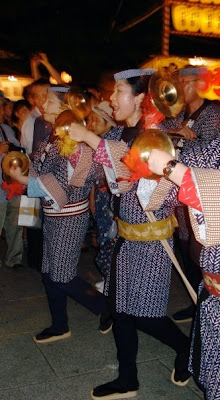
Far from being grim, Obon is a pretty jolly time. It's the middle of the summer holidays and a time for families to get together. There are lots of festivals, and kids wear cute yukata or jimbei pyjamas and all the old ladies in yukata dance around to the music of taiko drums. Big shrines like Yasukuni jinja have famous bon festivals, but every local town has them too. On summer nights, just follow the music and you'll find one. Since there are so many dead folk in town, it's also prime ghost season, and all the TV shows are gleefully telling spooky stories, usually about scary women with long hair. Some of the summer festivals also have ghost houses. The idea is that hearing a scary story will 'chill' you in the summer heat.

Girls in yukata

Games

Okonomiyaki

Yasukuni 

Yasukuni

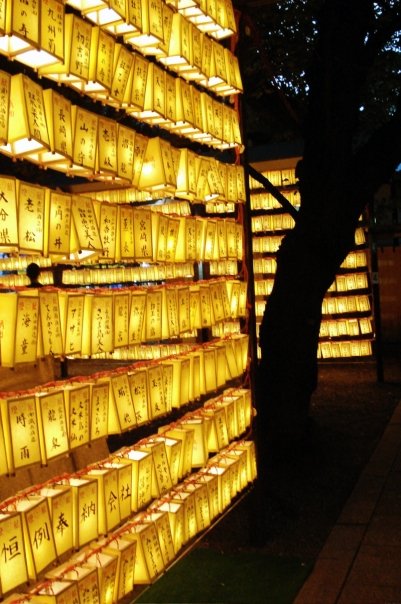
Some nebuta lanterns at Yasukuni

Dancers from Akita at the Yaskuni festival
The ghost house


I didn't have much experience of death or funerals growing up, but in Japan it seems pretty matter-of-fact. As a family, we go to the memorial park and clean the ancestor's grave stone, arrange fresh flowers, burn incense, pray, then go off for a nice lunch together. As the eldest son, my husband is responsible for cleaning the family grave, and he does it very thoroughly! You need 2 buckets of water and a zoukin - cleaning cloth (a normal wash cloth). One bucket of water is for cleaning, the other is to ladle over the grave to purify it. Parts of the grave such as the stones which hold the metal vases and the front part for burning incense can be moved for cleaning. We generally don't leave any food offerings, as it would encourage crows! Some people leave a cup of water, a can of beer or a cup of sake for their ancestors.

A typical Japanese cemetary - this is the 'modern' part with smaller graves. The cherry blossom trees in the back are lovely in Spring.

Hard at work cleaning

At home, we usually put out a little rice for the ancestors to share while we have dinner. The butsudan faces the TV so we can all watch TV together! To be honest, when I first moved to my husband's house, I found the Tardis-like butsudan sitting in the corner of the living room, a bit spooky, but I hardly even notice it now.

A few weeks ago, I went to my first 13th memorial service - this is a service held 12 years after death. It's similar to a funeral, but a little more simple - and kind of casual. Since it's been 12 years since my husband's uncle died, after the service, all the relatives enjoyed the chance to chat and catch up over lunch. If you ever have to go to a funeral or memorial service in Japan, you should wear black. The rule is subdued clothing - but stick with black and you can't go wrong. Of course, funerals happen more often in summer, so you'll be sweating. Shouganai. For men, a black or very dark suit and plain white shirt, plus a black tie is correct. It sounds obvious, but your socks and shoes should also be black. For women, a black skirt or trouser suit, dress (do I have to say this is NOT a sexy little black dress?), or black separates. Pantyhose should also be black. Shoes should be matte fabric or normal leather - nothing shiny or sparkly. The only jewellery should be a simple strand of pearls; no diamonds or flashy items. A plain black bag is best. You don't need a hat or anything. Don't forget a plain (ie white or dark) handkerchief. Kids can wear school uniform or simple "formal" clothes. For example, I saw some kids about 5 years old, the boy in navy shorts and a white shirt, the girl in a plain navy dress. You can probably pull together a black outfit, but if you need anything, department stores and also discount stores like Shimamura have "formal" departments where you can get everything pretty cheaply.

Just as at a wedding, you need to bring money. This is condolence money for the direct family, and will help them pay for the funeral / memorial service, which isn't cheap. We gave Y30,000 as it was close family, but if you are going to the funeral of a vague acquaintance I think Y5,000 to 10,000 would be fine. Obviously, you will put this in a funeral envelope, NOT a wedding envelope! Every convenience stores sells them - look out for the envelopes with black and silver decoration. While at a wedding it's nice to use new bank notes, at a funeral, you should use older notes, as this isn't the start of a new life. A lot of people also put the money face down in the envelope. It's not so important if you don't. We also gave money for the sotoba - the wooden name boards that are put behind a grave at the memorial service. If you walk through a Japanese cemetery, you'll see these standing behind a lot of grave stones. The family chipped in about Y3,000 each couple for a bunch of these.

After the priest has done a lot of chanting and prayers, you'll be invited up to the alter to give your own prayers. It's pretty simple; just follow everyone else. The incense tends to be in the form of chips or granules. Take a pinch of them from the dish in front of you, hold it up towards your forehead, then add it to the pile of burning incense on the left. Do this 3 times in total, then offer a prayer to the departed. That's basically all you have to do. A lot of people wear prayer beads around their hands when they pray at a funeral. These beads are called jyuzu or onenju and you can buy them at any Buddhist temple. Some friends told me they act as protection - in case the dead try to pull you into the next world with them. For the same reason, you shouldn't hold a funeral on a "Tomobiki" day, as it means "pulling friends" - it's good to pull all your friends together for a party, but not a funeral.

Lunch after the ceremony was a pretty relaxed affair and the food was delicious!


For the 13th memorial service, my relatives put a huge platter of fruit next to the grave, which they took back to the reception centre after the service. There was a separate table set up for the dead uncle, with his name on a stone tablet. They put the fruit and later, lunch dishes, on the table "for him". After we'd all eaten, those dishes got passed around to eat and the fruit was divvied up. When everyone had their fill of food and beer, one of the aunties handed out thank you gifts to everyone, much like at a wedding. My relatives went a little over the top. There were 5 packs of somen, a box of instant coffee, a huge box of sembei, a 12 pack of energy drinks, a bunch of assorted snacks and cakes and a melon from the fruit platter. Carrying that lot home on a bus and 3 trains was a challenge!

We were so tired when we got home that we almost forgot to sprinkle salt on each other - you should put salt on everyone coming back from a funeral to purify them, and I guess, to stop any spirits that followed you, from coming in. You should throw the salt on the person before they enter the genkan or entrance hall of your home. We put a little dish of salt by the front door before we left. Especially after a funeral, you should make sure to come home by a different route to the one you took to go there, so the spirits can't follow you home. This is why it's popular to go for lunch or coffee somewhere on the way home - drop those spirits off at the family restaurant! If you see a funeral service passing by, it's traditional to quickly hide your thumbs. Your thumbs represent your parents, and the superstition goes that if you don't hide them away from the funeral procession, your parents will die before you see them for the last time. Grim.

Phew! I think I'm all out of "fun funeral facts". Of course, death is a serious and solemn matter, but I kind of like that in Japan it is seen as an inevitable part of life, not such a shocking and mysterious thing.

Thursday, July 26, 2012

Eel day 土用牛の日

July 27th

Today is eel day! Doyou ushi no hi is the traditional day to eat unagi - eel - in Japan. Doyou is mid-summer; literally, it's the 18 days before autumn "officially" starts (called Risshuu) around August 8th (but it will still be stinking hot until at least September).

A supermarket flyer for eel day. Eel is extra expensive this year, due to a shortage of  elver.


Of course, if you like eel grilled over charcoal with a sweet, soy-based sauce, then any day is eel day, but on this mid-summer 'ox' day, eating eel is supposed to give you enough energy to deal with the heat and humidity. But the real origin of "eel day" was a flash of Edo era marketing. Because of the heat, most Edo-ites favoured cold noodles at this time of year, which made business hard for grilled eel restaurants. One restaurant owner consulted Hiraga Gennai, who was a renowned inventor, herbalist, satirical essayist and all-round 'renaissance' man. At the time, people believed that eating foods with the letter 'u' on ushi no hi (day of the ox) would help them endure the heat, (udon noodles and umeboshi are also popular on this day) so Gennai suggested the restaurant make a sign saying something like "today is ushi no hi, so eat unagi". It worked, and other restaurants soon followed suit, and a new tradition was born. To emphasise the "u" in unagi, restaurants  make long flags with a stylised eel forming a "u" shape. So why not eat "ushi" or beef? The practice of eating beef is actually pretty recent in Japan. Before the Meiji era, the main sources of animal protein were fish and fowl. 

There are so many good eel restaurants in Japan, and the preparation - usually a combination of steaming and grilling and basting with sweet soy sauce - makes them delicious. My image of eels growing up was those creepy snaky things that lived in lakes and nipped at ducks feet - or even nipped you if you went swimming. We didn't eat eel. I had it once, made by a friend's mother, who was Dutch. She chopped it into small pieces, floured it and pan-fried it, served with wedges of lemon. It was great (though a few friends missed out, as they were weirded out by the eel's resemblance to snake)!  


Getting into a good eel restaurant on eel day is almost impossible, so I'm going to make it at home for dinner tonight. I'm not preparing it myself of course; driving a nail through the wriggling animal's head and quickly filleting it is not in my cooking repertoire. I leave that to the pros, so I just bought a pre-cooked piece of kabayaki eel, nicely butterflied and sticky with sauce, which I will chop up and mix through rice for dinner. My "unagi gohan" has thinly sliced cucumbers and shredded shiso leaves to cut through the richness of the eel. After all, it's 35 degrees today!


Eel is apparently rich in vitamins A, B1, B2, D and E along with those beneficial fish oils, plus it's lighter than beef or pork, so it's easy to eat, even when you're feeling a bit lethargic. In Tokyo, one of my favourite eel restaurants is Izuei in Ueno. The main restaurant is just across from Shinobazu pond. There's a line right out the door today. They've been preparing eel for about 260 years, so they know what they're doing! Expect to pay around Y3,000 for an unagidon set, with grilled eel on rice, some sashimi, and very delicious eel liver soup. However, I like the rather quieter sister restaurant "Izuei Umigawa Tei", tucked away near Toshogu shrine, inside Ueno park. You can sit outside in the garden or in one of the traditional style rooms (you can choose tatami seating or table and chairs). 


Izuei Umigawa Tei

This mysterious box contains....

Lunch! A half eel / half tempura set.


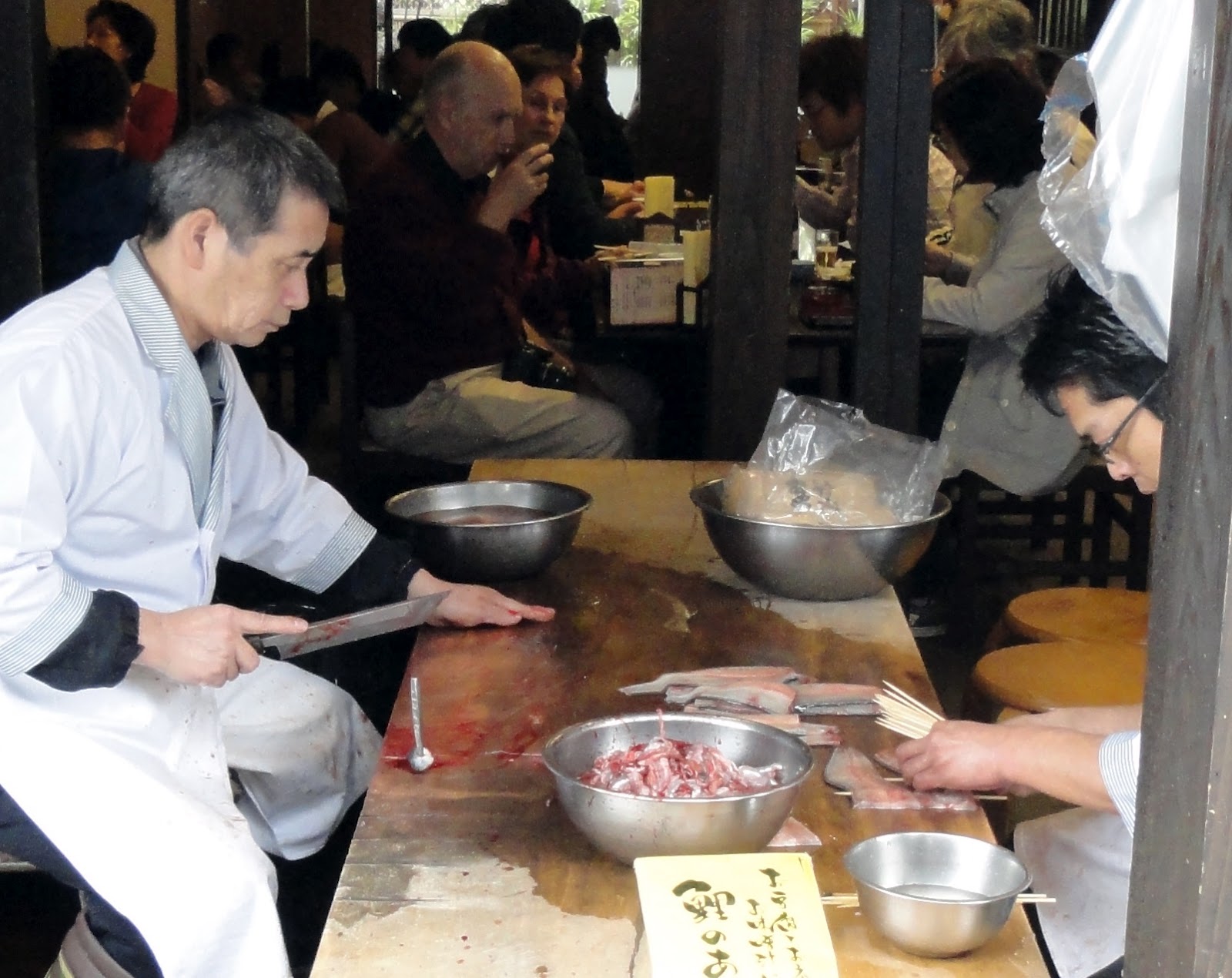
Eel lovers must visit Narita, the town in Chiba that's more famous for the international airport. The street that leads down to Narita San temple is lined with unagi restaurants, and here, you can see exactly how they are prepared. Chefs sit at tables out the front, grabbing squirming eels from buckets and deftly ... killing and preparing them. Venture inside and you can enjoy the results. 


Hard at work

Preparing the eel

Grilling is a hot job

"Irasshaimase!"

The finished result - about Y2,000 for a set with pickles and soup.

After eating, you can stroll the temple grounds to work off your lunch. The gardens of Narita San are really beautiful. I used to fly to Europe via Tokyo just because Japan Airlines had a good flight deal, with an overnight stay at one of the Narita Airport hotels. If only I had known how close by and how lovely Narita town was, I would have taken the free shuttle bus and had an eel feast! If you've got a few hours to kill at the airport, I really recommend a quick trip to Narita.

The road down to the temple, lined with eel restaurants.


Hitsumabushi


I've only been to Nagoya once and at that time, I didn't eat the regional specialty there, hitsumabushi. It's eel, prepared by grilling without steaming, so it tastes a little different and actually, I like it more than Tokyo style unagi, which is sometimes too soft. Hitsumabushi is eel served on rice, but you then divide your bowl into 4. The first quarter, you eat just as is, the next you add sliced negi and wasabi, then the third (my favourite), you make into a kind of ochazuke by adding a little dashi broth. The last is - your choice! While I didn't eat it in Nagoya, there is a branch of a well-known Nagoya eel restaurant called Hitsumabushi Nagoya Bincho (named after the special charcoal used for grilling the eels), in Ginza. It's on the 12th floor of the Maronnier Gate building (between Ginza and Yurakucho). The restaurant website has a little guide to eating hitsumabushi (in Japanese, but with photos) : http://www.hitsumabushi.co.jp/omeshiagari.html

Here's a hitsumabushi set. We also ordered some shirayaki (top left), which is cooked without the sauce. You get white soy sauce for dipping.

The restaurant has views over Yurakucho station. After lunch or dinner, you can check out Tokyu Hands in the same building. So, happy eel day, everyone!


Update:

Here's what we had for dinner. A nice piece of grilled eel, which I chopped up and put on rice with thinly sliced cucumber, negi, nori and shiso, plus a little extra of the sweet grilling sauce and some sansho pepper. It was good!