Showing posts with label Asakusa. Show all posts

Tuesday, December 18, 2012

Asakusa Hagoita ichi 浅草羽子板市

December 18th

Just a very quick post - yesterday I, along with hundreds of others, crowded into the grounds of Sensoji temple in Asakusa, for the annual Hagoita (Battledore) fair. Hagoita are paddles for playing a kind of badminton-type game, called hanetsuki. The hagoita on sale are strictly ornamental, though. They're believed to bring good luck for the new year, and are usually decorated with kabuki actors, but popular actors, sportspeople and anime characters are common too. They cost upwards of 2,000 although you can get painted ones for a little less.


To be honest, there were very few people buying (a friend tells me it's a true marker of consumer confidence - if no one is buying hagoita, it's a bad year generally, for retailers). There were hundreds of middle aged and old folks with expensive cameras snapping away, and the stall holders didn't seem to mind. When someone does buy a hagoita, you'll know, because the sellers and buyers (and the crowd around them) all do the special Edo style 3-3-3-1 clap. You'll hear it at rakugo performances too. It's called ippon tejime. The 'leader' calls "iyoo" and everyone responds with sets of 3 and then 1 clap. 3 x 3 adds up to 9 (see, I paid attention in maths class!) which in Japanese is ku. It also sounds like "pain" or "stress". The kanji for ku or kyu is 九. A single clap, 'da' is like an extra stroke added to the kanji, turning ku to maru 丸 or in other words, stress and pain is finished. Phew, sorry that was a clunky explanation, but I hope you get the idea!

The guys at the hagoita stalls are remarkably patient as everyone snaps away.


I think these were decorated by a local art school. There were some great and bizarre designs.

This one was based on the famous Hiroshige ukiyo-e. It would make a great, though pricey, souvenir of Asakusa.

Asakusa is always a jolly place to hang out, but when these Edo-era fairs are on, you can expect to see lots of folks in happi coats, local geisha posing and strolling shamisen players. I avoid the place on weekends, but the back streets are always nice and feel quite local. It's not just a tourist area; I go there to pick up accessories and sheet music for my shamisen, and when I wanted a yukata, I got one made to fit in Asakusa (quite an experience, as the store owner, in her 90's, barely reached my hip. Getting measured was a challenge!). The back streets and arcades are also full of retro Showa-era cafes and cheap restaurants. It has a real, downtown, working class feel.

Geisha photo op.

You'll find the real Showa spirit around here. 

Sunday, July 15, 2012

Houzuki market ほうずき市

July 9

Straight after Tanabata, it's time for the Houzuki market. Held in the grounds of Asakusa's Sensouji temple, there are about 200 vendors selling houzuki - chinese lantern plants or ground cherries.  It's been a popular event since Edo times.  The plant is used in traditional medicine, but the main use is as an offering for ancestors (Tokyo area marks Obon around July 15th, while other parts of Japan celebrate it on August 15th). Some of my friends said they remember playing with the vivid orange pods as kids - they look like papery balloons - and they make a lovely decoration.

The market vendors dress like Edo-era merchants and the combination of bright orange pods, cool green, and some very pretty plant sellers, brings the amateur photographers in droves. The tinkling sound of glass wind chimes (also for sale) and the cheerful cries of the vendors (and the smell of the nearby yakitori and takoyaki stalls) make it one of those perfect "summer in Japan" occasions.

As if that weren't enough, visiting Asakusa's Kannon temple on July 10th is said to be worth 46,000 visits! So you really get your money's worth! Early morning or early evening are the best times to visit, to avoid the crowds and the heat. The plants cost around 1,500 yen, but you can also buy branches of the orange pods for around 800 yen, and crowd watching is free. If you go there in the afternoon, be sure to stop by Amuse Museum, just off to the right of Sensouji. The museum always has interesting craft displays and a great shop...but after 6pm head upstairs to Bar Six, tucked away above Asakusa, with great views over the temple complex.

The sounds and smells of summer: fuurin (wind chimes) and katori buta (pig shapes mosquito coil holders)

Skytree!

Houzuki sellers


I bought a little basket of pods.
Sensouji as seen from Bar Six

Saturday, July 14, 2012

Tanabata 七夕

July 7

I've been terribly neglectful, lately. I could blame it on the hot weather, or the fact that there have been about a dozen summer festivals around Tokyo already, but really, I've just been lazy.

Last weekend, the area around Asakusa was the place to be. The Iriya Asagao market ("Morning Glory" plants), the Tanabata Festival around Kappabashi street and the Houzuki market ("Ground Cherry" or Chinese Lantern plant) in the grounds of Sensouji, all fell around the same time.

As usual, Tanabata - the star festival - fell on a cloudy day. The story of two gods (the stars Vega and Altair) who fell in love, neglected their duties and were separated, only to meet on July 7, came from China. It was apparently adopted by the Heian court in Kyoto and later became popular with the general population in the Edo period. According to the legend, if it rains on Tanabata, the literally star-crossed lovers cannot meet. It rained buckets this year, so I guess they'll have to try again next year.  If you write a wish and tie it to a bamboo branch, it might come true - you're supposed to wish for improved skills, so just wishing for money isn't going to work.

Tanabata is very popular with little kids. All the kindergartens and elementary schools around my place decorated their gates with bamboo and paper decorations. The sound of the bamboo rustling makes you feel cooler. The decorations - paper lanterns and paper chains remind me of the Christmas decorations we made as kids in kindergarten in Australia.

There are a few major Tanabata festivals including  Hiratsuka in Kanagawa and Asakusa in Tokyo. Asakusa's festival is held along Kappabashi street, which is famous for selling kitchenware. You get the real downtown atmosphere here - stalls selling cold cucumbers on sticks (a very healthy pre-curser to the popsicle), wedges of watermelon and bottles of ramune soda; the local hula class of old ladies puts on a little show; there's a monkey doing tricks (which looks rather sad); catching goldfish games and a kind of "rock paper scissors" showdown, which I didn't really understand, but looked very exciting! It's one of the first chances in the year to wear cotton yukata or jinbei (a kind of pajamas).

Don't worry, if you missed it - Sendai also has a famous Tanabata festival around August 7th.

Here are some photos from Kappabashi:


The decorations feature a "kappa", the symbol of Kappabashi

All these little stars were made of paper

Wishes and decorations on bamboo

Strolling in yukata


Catching fish

Kind of sad monkey

Hula hooper and the little girls from The Shining


Gold fish are a typical summer motif. How long will it live?

Enjoying watermelon

Putting up wishes


Checking out the "stadium"

This was a complex-looking hand game, something like a geisha drinking game. Can anyone explain it?

Blue and white is the most popular colour scheme for yukata

I think he won the game.


Thursday, April 12, 2012

Matsunouchi

You can keep your New Year's decorations up until about January 7th. You'll see big kado matsu outside stores and hotels, made of bamboo and pine branches and smaller arrangements of pine outside houses to encourage the new year god to visit and bring good luck. So this time is known as "matsunouchi" - literally 'during the pine'. You can buy pine branches and shime kazari decorations (usually featuring shinto rope to keep out bad spirits and lucky symbols like lobsters and oranges and kelp) at the supermarket for your front door or alcove, from about 250 yen (plastic and straw). These days a lot of people don't even bother.

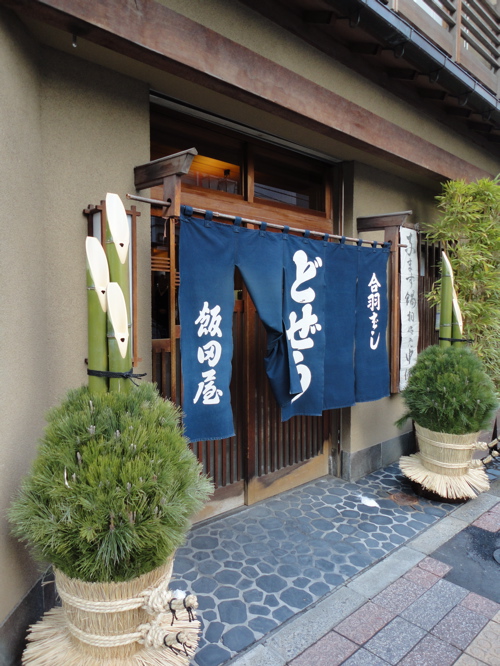
The kadomatsu outside Dozeu Iidaya, a very famous dojou (loach) restaurant in Asakusa

We also had a kagami mochi in the house - mochi cakes shaped like mirrors, because gods were meant to live in mirrors. Remember that next time you're preening in the bathroom mirror! After January 11th, you can break the mochi and put it in soup. You can buy the kagami mochi formed inside a plastic cover, or you can make your own mochi - which few people do these days. In Asakusa, I came across an elaborate kagami mochi with a real lobster and real fruit etc. It was in the window of Bunsendo, a famous fan shop which supplies kabuki actors.

kagami mochi in Bunsendo


I went to Ginza to see all the elaborate New Year decorations - far more subdued than Christmas, but very beautiful. I stopped off at Higashiya, a wonderful sweet store and cafe in the POLA building (on Chuo dori, Ginza 1-7-7, 2F). I wanted to buy hanabira mochi, which is a traditional sweet to have with the year's first tea ceremony. For a change, I tried yuzu green tea, made with whole yuzu; very refreshing. I'm afraid the dining options in the cafe are quite expensive, so I opted for the shio musubi - a simple, salted rice ball wrapped in nori. Wow. It was the most delicious one I've ever tasted, and I realised the ones I make for my huband's lunch are pretty bland in comparison. Since it was New Year, they also offered free sweet, warm sake!


Hanabira mochi is sweet, but not overly so. The mochi is wrapped around miso paste and sweetened gobo - burdock. The slightly "turnip-ish" burdock taste is a nice balance to the sweet miso and mochi.

Hanabira mochi